
3D Measurement and Quality Control: Components, Tools, and Products
sigma3D offers professional 3D scanning services for a wide range of contract measurement applications in the fields of design, production, and development. From cell phone cases to wind turbine blades—we can measure it.
State-of-the-art optical 3D measurement technology? An experienced team of engineers? An in-house metrology lab? We have everything you need for precise component measurement that meets the highest surface finish requirements! For every job we undertake through our 3D scanning service, efficient and fast execution is just as important to us as 100% reliable measurement results.
After all, we know that the quality of a contract measurement directly determines the quality of your work and production, as well as compliance with standards!
As a result, you’ll receive high-resolution scan data from us, including a 3D model of your fully captured component. The generated scan fully represents your component as a digital polygonal model: You can virtually adjust the orientation at any time, compare data, and gain new insights through further analysis. If your measurement object is too large to ship, we’ll be happy to come to you and measure your components using our mobile 3D measurement technology.
We’re happy to assist you with any questions regarding 3D component measurement—just contact us!
Your benefits at a glance:
We uphold the highest standards of quality and precision in all contract measurement services. Once your item arrives at our facility, it is taken to our in-house measurement lab, where we have dedicated facilities equipped with state-of-the-art measurement technology. In this specialized facility, our measurement team—composed of experienced engineers—performs optical measurements of components, products, or machine parts.
Once the optimal measurement setup is in place, your object is digitally captured using a scan camera or a scan arm, depending on its size and shape. Non-contact optical 3D measurement enables an accuracy of 0.02 to 0.2 mm. Unlike tactile measurement, 3D scanning also allows us to fully capture free-form surfaces.
In addition, we offer mobile 3D measurement services: Components or machines that are too large and heavy to be transported to our facility will be measured by our team directly at your location. We’d be happy to advise you personally on this—please contact us!
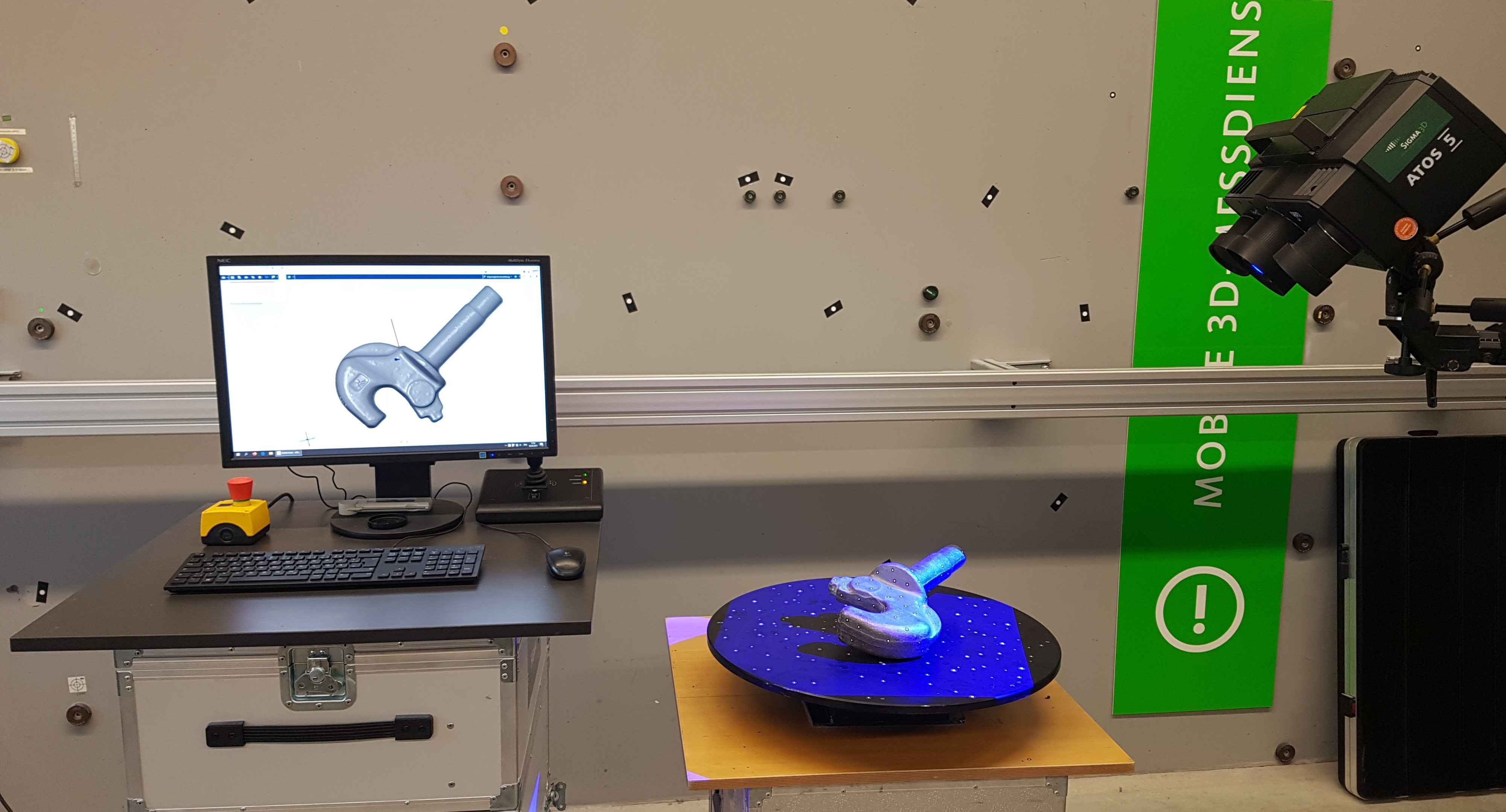
When performing optical 3D scanning of components, we always capture the entire object for you in order to create a digital model. This approach has two advantages:
Advantage 1: Versatile STL data
We provide you with the digitized component as an STL data set—a polygonal model—which you can use with the viewer application we provide. This allows you to easily analyze and process all the data and quickly share it with employees and partners anywhere in the world.
Advantage 2: No need to remeasure ever again!
You can always evaluate, at any later time, all the areas that did not appear relevant prior to the component measurement. You’ll never again need to incur additional costs for outsourced measurement of the object.
In addition, upon request, we’ll create a detailed measurement report tailored to your specific requirements. If the 3D scanning of components reveals any defects, we’ll be happy to assist you with the analysis, drawing on our many years of experience.

Automotive - Oil Pan Cover

Tank

Support Plate

Screw Conveyor

Hand

Cartridge nozzle

Diffuser

Hair Dryer

Coupling hook

Ultrasonic Sonotrode

Stator

Mold Insert
In addition to the highest precision, optical 3D measurement offers one key advantage above all else: speed. We want you to be able to use the results of your contract measurement services without a long wait. That’s why, in our measurement lab, we combine high-performance technology with years of experience and efficient processes.
First, we work with you to define the parameters of the measurement. Then you send us your component; we handle the entire 3D scanning service, and you’ll receive the results from us within two to five business days of receipt!
If the component is needed for critical production processes, we’ll schedule a specific measurement appointment with you. This minimizes any potential downtime and the associated costs for you.
A component that doesn’t function as intended after installation? A machine that breaks down due to a worn-out part? A defective batch of product samples that the customer rejects?
In all these cases, professional 3D quality control from sigma3D is the solution, allowing you to analyze a product or component down to the last detail in the shortest possible time. Identify and correct quality defects even before production or installation—and save time and money by minimizing assembly times and test runs.
Depending on your requirements, we use various methods for our 3D quality control to compare the captured actual data with your target data. Based on this, we create customized analyses and evaluations for you, such as target-actual comparisons, initial sample inspection reports, or evaluations of specific inspection characteristics. And: If you’re facing a specific metrological challenge, our many years of experience guarantee that we’ll find a solution.
Deviation analysis is one of the fastest methods of 3D quality control: We align our 3D scan according to your specifications and compare any dimensions of the actual product with those of the CAD reference object. A visual false-color comparison shows you the deviations in dimensions and shape from the theoretical data set. The evaluation is performed in accordance with the DIN standard EN ISO 1101 Geometric Product Specification (GPS). For example:

Definition von Bezügen
Ausrichtung über Referenzstellen (RPS-Ausrichtung)

Auswertung entsprechend DIN EN ISO 1101 - GPS (Geometrische Produktspezifikation)
Auswertung Schanierbohrungen (Positionstoleranz)

Flächenhafter Soll-Ist-Vergleich
Die Darstellung der 3D-Abweichungen in einer Farbkarte ermöglicht einen schnellen optischen Eindruck.

Flächenhafter Soll-Ist-Vergleich
Eine Darstellung über definierte Oberflächen Toleranz-Zonen ermöglicht eine Darstellung in i.O (in Ordnung) oder n.i.O (nicht in Ordnung).

Abweichungen an definierten Sollpunkten
Für eine detaillierte Analyse ermöglichen Vergleichspunkte eine exakte und wiederholbare Abweichungsanzeige zu definierten Soll-Punkten auf dem CAD.
Diese Punkte lassen sich auch für eine SPC-Analyse verwenden.

Abweichungen an Beschnitten
Die Auswertung von beschnittenen Kanten erfolgt über einen Kantenpunkt und einen Bezugspunkt in einem definierten Abstand zur Kante. Somit wird die Kante, wie aber auch die Rückfederung des Bauteils, bewertet.

Abweichungen an Bördelkanten
Die Auswertung von Bördelkanten erfolgt über einen Kantenpunkt und einen Bezugspunkt in einem definierten Abstand zur Kante. Somit wird die Kante, wie aber auch die Rückfederung des Bauteils bewertet.

Übersicht Schnitte
Schnitte werden für eine Vielzahl von Auswertungen verwendet. Messschieber, Profillehren oder Spalt und Bündigkeitsmessungen.
Schnitt-Farbvergleich
Die Darstellung der 3D-Abweichungen in einer Farbkarte ermöglicht einen schnellen optischen Eindruck.
Schnitt-Toleranzband
Eine Darstellung über definierte Oberflächen Toleranz-Zonen ermöglicht eine Darstellung in i.O (in Ordnung) oder n.i.O (nicht in Ordnung).
Auswertung 2D-Elemente - Messschieber
Somit wird der Messschieber aus der Werkstattumgebung in die 3D-Welt übertragen.
Auswertung 2D-Elemente - Profillehre
Neben der Messung von konstanten und variablen Radien können Profillehren auch die Stufenhöhe, den Tangentenwinkel sowie Tangentenpunkte und theoretische scharfe Kantenpunkte erfassen.
Somit wird die Profillehre aus der Werkstattumgebung in die 3D-Welt übertragen.
Mit der Profillehre lassen sich "Tornadolinien" effizient auswerten.
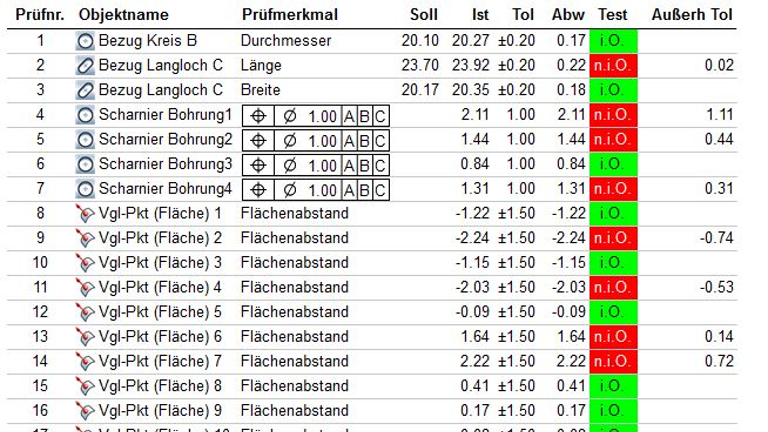
Dokumentation in einem Prüfmerkmalsplan (PMP)
Auswertung aller Prüfmerkmale in tabellarischer Form.
Der <link internal-link>Prüfmerkmalsplan lässt sich einfach als CSV- bzw. Excel-Datei weiterverarbeiten.

Cut-Color Comparison
Displaying the 3D deviations on a color chart provides a quick visual overview.

Cut Tolerance Band
A representation of defined surface tolerance zones allows for a classification as OK (in order) or NOK (not in order).

Analysis of 2D Elements - Caliper
This transfers the caliper from the workshop environment into the 3D world.

Analysis of 2D Elements - Profile Gauge
In addition to measuring constant and variable radii, profile gauges can also measure step height, the tangent angle, as well as tangent points and theoretical sharp-edge points.
This brings the profile gauge from the workshop environment into the 3D world.
The profile gauge can be used to efficiently evaluate “tornado lines.”

Documentation in an Inspection Characteristic Plan (PMP)
Evaluation of all inspection characteristics in tabular form.
The <link internal-link>Inspection characteristic plan can be easily processed further as a CSV or Excel file.
A surface-based target-actual comparison is a visual representation of 3D deviations: These represent the distance between a measurement point and its corresponding CAD surface.
For quick and easy 3D quality control, we map all 3D deviations for you on a color map. We can customize this visualization, for example, by selecting colors or defining surface tolerance zones with “OK” or “Not OK” markings. For a target-actual comparison, we can use various analysis methods depending on the shape and type of your measurement object:
Deviations at defined target points: Defined target points on the CAD model enable an exact and repeatable deviation analysis. The results can be interpreted as equivalent to the measured values from a tactile coordinate measuring machine—with the evaluation time being independent of the number of target points.
Deviations at edges: We evaluate trimmed or flanged edges using an edge point and a reference point at a defined distance from the edge. This allows us to evaluate both the edge and the springback of the component.
Deviations of defined cross-sections: Cross-sections are used for a wide range of evaluations and enable the functions of a caliper and profile gauge, as well as gap and flushness measurements, on the 3D model. In this way, various measurement tools from the workshop environment can be transferred to the 3D world for your 3D quality control.
Before beginning mass production of components or products, it is necessary to prepare an initial sample inspection report (EMPB for short) for a series of initial samples. As part of our 3D quality control process, we determine—depending on your specific requirements—anywhere from a single measurement to several hundred relevant measurements for your EMPB.
We typically provide you with the final EMPB—containing meaningful data comparing actual values to target values—in the form of a drawing. You can immediately identify any deviations within the series and determine whether they originate in the production process or at the production machine. As soon as the initial sample inspection report for your component or product meets the requirements of 3D quality control, you can use it as proof for partners and customers.
For assemblies, form and position tolerances are a means of defining design and drawing requirements in relation to actual function and relationships. As part of our 3D quality control process, we evaluate all requirements in accordance with form and position tolerances.
This is done using geometric tolerance zones within which a measured value must fall. We make the interpretation of the evaluated values clear and simple for you: The result is “OK” or “not OK.” Our 3D quality control is performed in accordance with DIN EN ISO 1101 Geometric Product Specification (GPS).
The fundamental prerequisite for any analysis within the framework of our 3D quality control is registration. Registration is the process by which the digitized 3D coordinates of a point cloud are transformed into the same reference coordinate system—for example, a CAD target data set. In addition to alignment using a reference point system (RPS alignment), we use other methods such as “surface best-fit” and alignment via features.
Custom Measurement Programs for Your Test Characteristic Plan (PMP)
As part of our 3D quality control services, we create measurement programs for you based on your inspection characteristic plan (PMP). In doing so, we combine our engineering expertise with extensive application know-how.
Thanks to our in-house programming using the Polyworks Inspector measurement program, you benefit from our experience in developing effective evaluation strategies. The evaluation is performed in accordance with the DIN standard DIN EN ISO 1101 GPS (Geometric Product Specification).
Day 1: You pack the component and send it to us.

Day 2: The component arrives at our facility by 10:00 a.m. and is transferred to our metrology room for 3D optical measurement.

Day 3: You will receive your item back via a return shipment, and we will provide you with the results of our contract measurement.

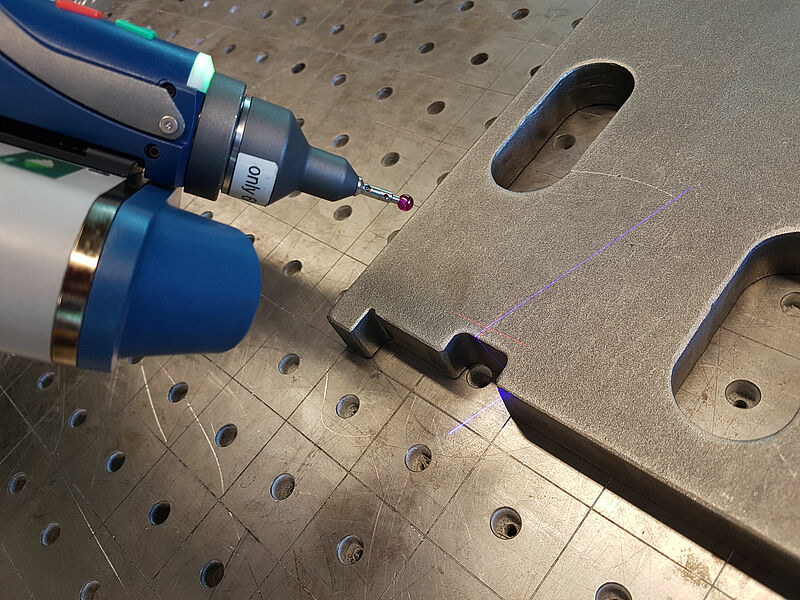
Quality Control: Waterjet Cutters & Plasma Cutters
What added value did component measurement provide for our customers?
Thanks to 3D measurement of components from its waterjet and plasma cutters, our customer obtained comprehensive and meaningful data for its quality control. Through a so-called cut analysis, they were able to evaluate every area of the cut against their target data. Based on this analysis, the cutting parameters could be adjusted quickly and efficiently. The result: optimal and precise cutting results.
Thanks to our 3D scanning service, the customer is also able to minimize the steps required to adjust the cutting parameters, thereby saving valuable time and money.
What was measured?
Our engineers perform cut-contour measurements on plates from waterjet and plasma cutters. The plates measured 60 x 30 x 3 cm—ideal for component measurement directly in our metrology lab.
How long did the component measurement take?
After delivery and setup, the plates were scanned precisely and completely within one day.
What optical measurement technology did we use?
For the optical 3D measurement of the plates, we used our ScanArm to capture the entire cut. Geometric features such as holes and slotted holes were additionally measured using a tactile probe.
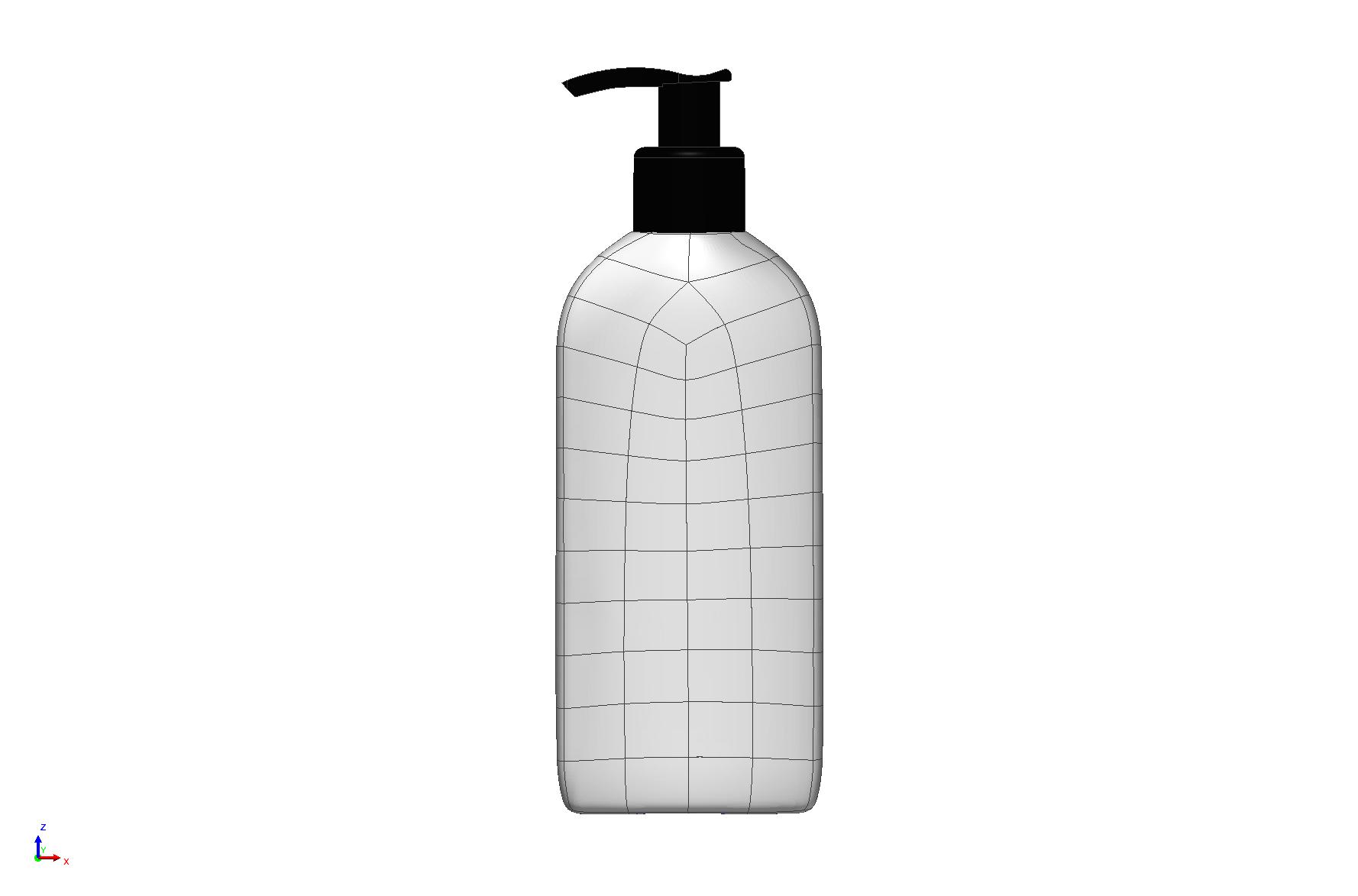
Surface Reconstruction: Packaging Machines for Bottles
What added value did component measurement provide for our customers?
Finished bottles containing dish soap and shampoo are to be packed into cartons for transport and shipping. However, our customer did not have any CAD data available to plan the packaging machine for the various bottle types early on.
Using our 3D scanning service, we were able to quickly and easily scan the “components,” obtain precise measurement data, and generate all the necessary CAD models from it. This allowed our customer to virtually design their packaging machine and avoid a lengthy and costly on-site adjustment process. Our service saved the client a significant amount of time and money.
What was measured?
Measuring bottles for the design of packaging machines was a project from a typical application area of 3D measurement: mechanical engineering. Measuring just 10 x 15 cm, the bottles could be easily measured in our measurement room.
How long did the component measurement take?
Due to their simple shape and small size, the bottles could be scanned within a single day.
What optical measurement technology did we use?
For the optical 3D measurement of the surfaces of consumer goods such as bottles, we used our ScanCamera.
Do you have questions about component measurement and 3D quality control? We’d be happy to advise you personally and provide you with a customized quote upon request.
Phone: +49 2542 91898-0