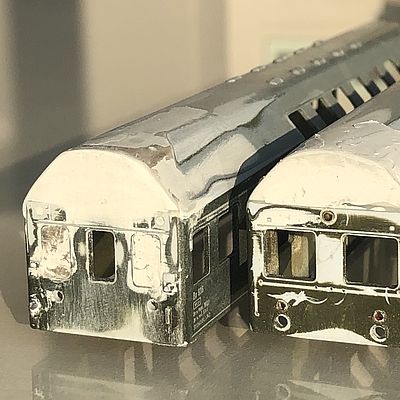
Model railroading has been experiencing a rapid resurgence lately. For serious model railroaders, however, the focus is not on purchasing new trains, but rather on building new ones or modifying existing mass-produced models.
That’s exactly what Mr. Beylich does. He is a member of a club dedicated to preserving old model trains from the former GDR.
“Modifying existing production models was also the inspiration for the project described here in the TT scale (1:120). The double-decker trains offered by the manufacturer (Berliner TT-Bahnen) were produced from the 1960s onward, continuing even after German reunification. They represent the original models from the 1960s and are technically at that level as well. While there were further developments in the H0 scale (1:87), for example, these were absent for the TT scale, even though many model railroaders in this sector would have liked to see them.
“That was the reason why I decided to fill this gap and initially produce a small series of the double-decker trains built in the late 1970s,” said Mr. Beylich about his work.
To ensure an exact replica, the model trains will be scanned and CAD data will be created. This data will be used, on the one hand, to reproduce the car windows and, on the other hand, to redesign the fronts of a newer car type.
In both cases, the 3D models created by sigma3D formed the basis for production.
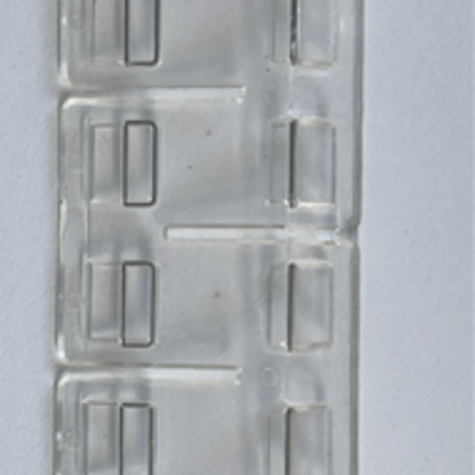
The new car windows are to be replaced and installed based on the design of the existing car windows. The challenge here lies in the high degree of precision required, as the new windows must fit into the existing recesses in the cars.
The required tolerance of ±0.05 mm for the newly manufactured components must therefore be maintained, and the components must be scanned with the appropriate precision. For this reason, the GOM ATOS 5 measurement system was used, featuring a 170-mm measurement field and an accuracy of less than 0.005 mm in ball-to-ball distance deviation. Due to the transparency of the car windows, they were sprayed with a powder (titanium oxide) prior to scanning to ensure a precise measurement result.
The scan data from the ATOS 5 forms the basis for a precise reverse engineering process. The scan data was converted into a CAD model in STEP format for further processing and forwarded to the mold manufacturer for the production of the injection mold.
For further processing, the window frames were printed by Herzog-Industriedruck. sigma3D provided the relevant data to Herzog-Industriedruck to ensure a smoother workflow.
In the injection molding process, molten plastic is forced under pressure into the cavities of a mold. The geometries of the cavities replicate the shape of the part, which is how the parts are manufactured. To manufacture the mold, CAD data for the respective part—in this case, the car windows—is required.
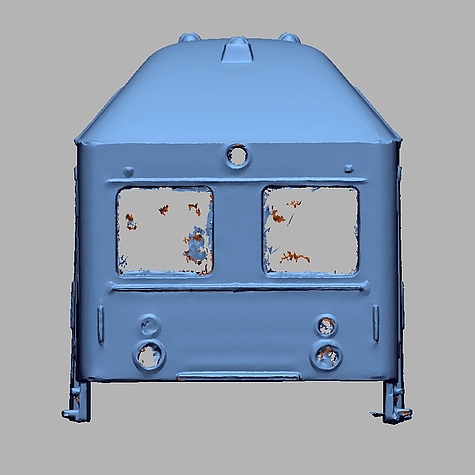
Another task is to model the front end of the 1975 train model. What makes this special is that this train model was never actually produced as a model train. The goal is therefore to adapt the model—based on existing models from earlier production years—so that it can be modified and glued onto an older model series.
Since there is no template for developing the car front, the only option for data acquisition was an indirect approach. As in the first part, the components—in this case, the cars—were scanned using the GOM ATOS 5 scanner. Subsequently, the front and rear ends of the cars from the existing model year were reconstructed, with even the finest details, such as power cables running along the exterior, being modeled.
Afterward, the design differences of the successor model (modified windows, running board, handrails) were incorporated into the design. The customer provided the relevant information. Using existing photos of the subsequent model year, the customer carefully examined the differences and extracted the dimensions of the corresponding components. With the help of a scaling factor, the modified geometries were then modeled to the correct dimensions and exported as a CAD model. Based on this, the car fronts are now printed using a 3D printer and then installed accordingly.
Since this project requires a high degree of printing accuracy, the more common—but also less expensive—FDM process is being used here instead of the more precise SLA printing.
In the FDM 3D printing process, heated plastic is extruded in layers onto a build plate through a fine nozzle. These layers then combine to form the final part.
The finished components—that is, the train windows and the front panels—have now been installed into the existing train parts, and we’re pleased to hear that everything fits as planned.